


Preparing for IVF: What You Can Control & How to Prepare
Date: Monday 28th September 2026Time: 7:00PM (BST)Location: Online Click here to watch the recording. About this webinar If you are...
YOUR CART IS EMPTY
 Third-Party Tested

Choline
£17.95
Capsule

Femceive
£34.95
Capsule

Vital DHA
£20.50
Capsule

Vitamin D Spray
£13.50
Spray
Third-Party Tested
Article
Posted on
Including choline, NAC, myo-inositol, alpha lipoic acid, magnesium and DHA, and how each may support a personalised preconception nutrition plan.
Most people trying to conceive have heard of folate, vitamin D and omega-3. Fewer have heard of choline, NAC, myo-inositol, alpha lipoic acid or the specific role magnesium plays in preconception health. This article looks at six of these lesser-discussed fertility nutrients and the different biological pathways each one is involved in.
These nutrients do not replace folate, vitamin D, omega-3, a balanced diet or medical advice. They are additional pieces of the picture, and each one is involved in a different process: choline in methylation and cell membrane structure, NAC in glutathione production and oxidative stress balance, myo-inositol in insulin signalling and ovarian function, alpha lipoic acid in antioxidant activity, magnesium in enzyme function and nervous system health, and DHA in omega-3 status and cell membrane health. Of the six, choline is one of the most overlooked, despite growing interest in its role in preconception nutrition for both women and men.
This article is not a supplement checklist that everyone needs to follow. It is a guide to six nutrients worth reviewing as part of a personalised preconception plan, especially if you are trying to understand where your diet or current supplement routine may have gaps.
Short answer
Some fertility nutrients are well known, such as folate and vitamin D, while others are often overlooked. Choline, NAC, myo-inositol, alpha lipoic acid, magnesium and DHA may each support different aspects of preconception health, from methylation and cell membrane structure to oxidative stress balance, insulin signalling, enzyme function and omega-3 status. They are not interchangeable, but they can help identify nutrient gaps worth reviewing when trying to conceive.
| Nutrient | Main pathway |
|---|---|
| Choline | Methylation, cell membrane structure and early cellular development. |
| NAC | Glutathione production and oxidative stress balance. |
| Myo-inositol | Insulin signalling, ovarian function and PCOS (PMOS)-related fertility support. |
| Alpha lipoic acid | Antioxidant activity and insulin sensitivity, especially in PCOS (PMOS)-related metabolic contexts. |
| Magnesium | Enzyme function, nervous system support and wider metabolic health. |
| DHA / omega-3 | Cell membrane health, omega-3 status and inflammatory balance as part of a wider preconception plan. |
Egg and sperm cells are formed over weeks to months, and both are sensitive to nutrient status, oxidative stress and metabolic signalling during that time.[17] Folate and vitamin D are well established in preconception guidance, but they are not the only nutrients involved.
Methylation, cell membrane structure, insulin signalling and antioxidant defence are all separate biological processes, and each depends on a different set of nutrients. Reviewing where your diet, lifestyle or current supplement routine may fall short of these processes is a reasonable part of preparing for conception, for both female and male fertility.
Choline is one of the most overlooked preconception nutrients. It supports methylation, cell membrane structure and early cellular development, all of which are relevant before conception.[1]
Choline is a methyl donor, meaning it contributes to methylation reactions involved in DNA regulation and cell signalling.[1] It also forms part of phosphatidylcholine, a key structural component of cell membranes, which is relevant to both egg and sperm cell biology and to early cellular development.[1][2]
Some research has also looked at choline-related gene variants and sperm concentration, suggesting choline metabolism may be relevant to male fertility, though this is an emerging area rather than proof that supplementation changes sperm outcomes.[3] You can read more in our guide to choline for fertility.
Dietary choline intake is often lower than reference values, particularly for people who eat few eggs, liver, meat or dairy products, which is one reason choline is increasingly discussed as a preconception nutrient rather than only a pregnancy nutrient. The European Food Safety Authority has set an adequate intake reference of around 400mg per day for adult women, rising further in pregnancy and lactation.[20] For a practical list of options, see our guide to best choline foods before pregnancy.
Choline does not replace folate, but it works alongside folate through related methylation pathways. It also has separate roles in cell membrane structure and early cellular development, which is why choline is increasingly discussed as part of preconception nutrition rather than only pregnancy nutrition.
This also means that taking a folate-containing multivitamin does not automatically cover choline, since the two nutrients are metabolised differently and most standard prenatal formulas contain only small amounts of choline, if any.

Zita West Choline provides targeted choline support for those reviewing their preconception nutrition. Choline is involved in methylation and cell membrane structure, and can be considered alongside folate as part of a personalised fertility nutrition plan. Each daily serving (two capsules) provides 400mg choline.
Shop nowNAC, or N-acetylcysteine, is often discussed in fertility nutrition because it supports glutathione production, one of the body's key antioxidant pathways.[4]
Glutathione helps neutralise oxidative stress, and both egg and sperm cells are considered sensitive to oxidative damage during their development.[4][5] This is why NAC is often discussed alongside oxidative stress balance in fertility nutrition. It is best understood as support for one antioxidant pathway among several, rather than a standalone fertility treatment, and reviews of antioxidant use in fertility caution against overstating benefits for pregnancy or IVF outcomes specifically.[6]
NAC differs from choline in that choline is primarily involved in methylation and cell membrane structure, while NAC's main role is antioxidant support through glutathione. NAC also differs from CoQ10, a related nutrient sometimes reviewed alongside it: CoQ10 is mainly discussed in relation to mitochondrial energy production within egg cells, whereas NAC's main role is replenishing glutathione.[18][19] Some people choose to review CoQ10 when trying to conceive alongside NAC, though the two work through different mechanisms. For more on how these nutrients relate to one another, see our guide to NAC, choline and mitochondrial support for fertility.
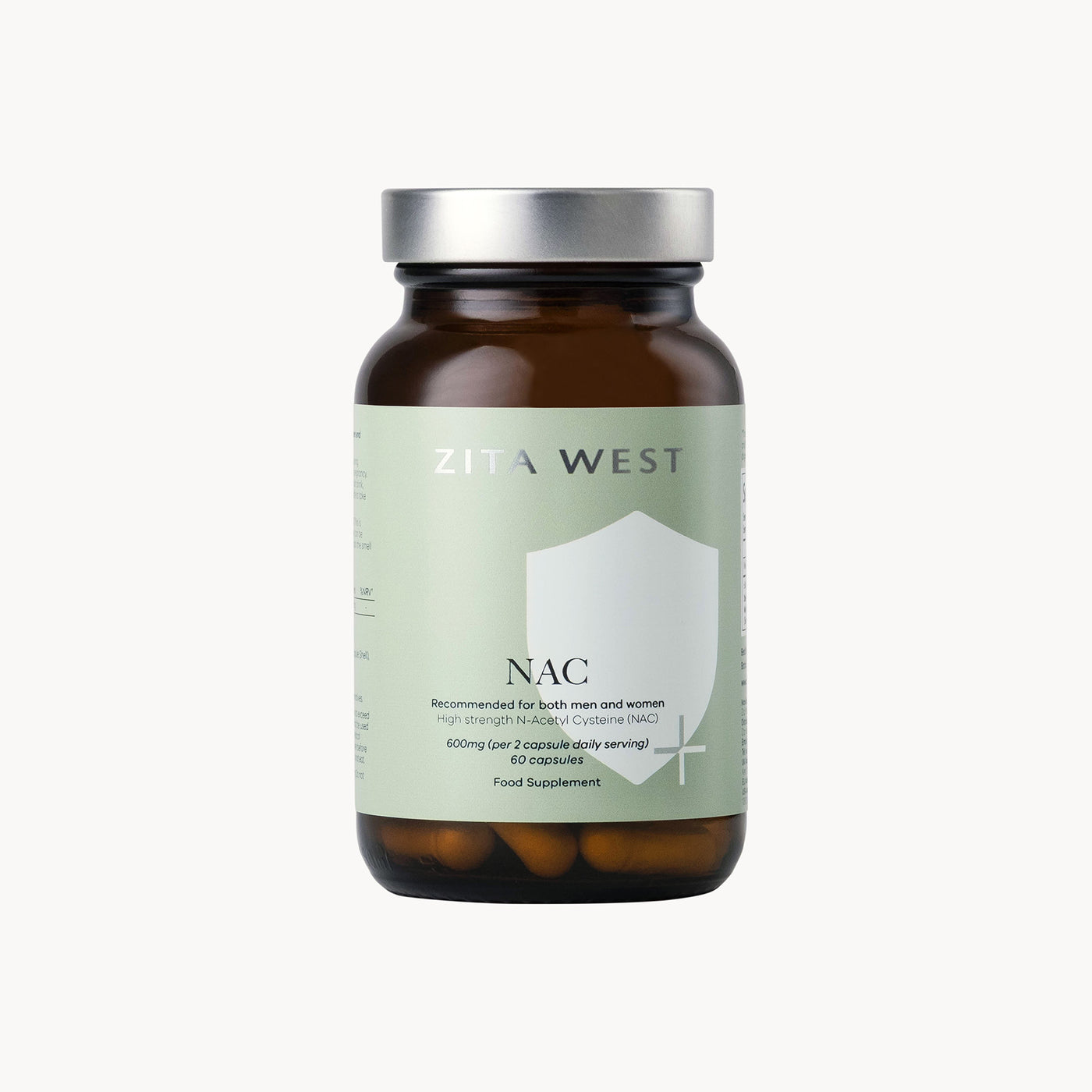
Zita West NAC provides targeted N-acetylcysteine support for those reviewing antioxidant pathways as part of preconception nutrition. NAC is involved in glutathione production and may be considered where oxidative stress balance is a focus. Each daily serving (two capsules) provides 600mg NAC.
Shop nowMyo-inositol is most often discussed in fertility nutrition in relation to insulin signalling, ovarian function and PCOS (PMOS).
Polycystic Ovary Syndrome, or PCOS, is now also referred to as Polyendocrine Metabolic Ovarian Syndrome (PMOS). You can read more about what this means for hormones and fertility in our guide: PCOS is now also referred to as PMOS.
Myo-inositol has been studied for its role in supporting insulin sensitivity, which is often relevant in PCOS (PMOS), along with ovarian function and ovulatory regularity.[11][12][13] Research summarised in the 2023 international evidence-based PCOS guidelines describes myo-inositol's role in insulin signalling and ovarian function, while noting that evidence quality varies across outcomes and that it is not positioned as a treatment that works identically for everyone.[13] Oxidative stress is also part of the picture in PCOS (PMOS)-related fertility, and inositol has been studied alongside antioxidants in this context.[5]

Myo-inositol is different from choline: choline is mainly involved in methylation and cell membrane structure, while myo-inositol's main relevance is insulin signalling and ovarian function. The two are increasingly discussed together because they support different, complementary pathways rather than overlapping ones. Myo-inositol is also not a universal fertility supplement for everyone; its clearest relevance is for those with PCOS (PMOS), insulin resistance or irregular ovulation. Read more in our comparison: choline and inositol for fertility.

Zita West Inositol & Folate combines myo-inositol with methylfolate for those reviewing insulin signalling, ovarian function and PCOS (PMOS)-related fertility nutrition, and can be considered as part of a personalised preconception plan. Each daily dose provides 4g myo-inositol and 200mcg folate in a powder format.
Shop nowAlpha lipoic acid, or ALA, is an antioxidant compound often discussed in relation to metabolic health, oxidative stress and insulin sensitivity.
ALA is unusual among antioxidants because it is both water- and fat-soluble, which allows it to work across different tissue types and to help regenerate other antioxidants. In the context of PCOS (PMOS)-related metabolic health, a systematic review and meta-analysis found that ALA supplementation was associated with improvements in fasting blood sugar and insulin resistance (HOMA-IR), though effects on hormonal and lipid markers were less consistent.[7] A separate review concluded that ALA does not appear to meaningfully influence reproductive hormones and should not be recommended routinely for PCOS (PMOS) without stronger evidence.[8]
Some studies have explored alpha lipoic acid in PCOS (PMOS)-related metabolic health, but the evidence does not support presenting it as a routine fertility treatment. For this reason, ALA is best understood as one antioxidant among several worth reviewing in a metabolic or PCOS (PMOS) context, rather than a nutrient that reliably changes fertility outcomes on its own.

Zita West Alpha Lipoic Acid provides a high-strength, stable form of ALA (a 50:50 blend of R-ALA and S-ALA) for those reviewing antioxidant and metabolic pathways as part of preconception nutrition. Each daily capsule provides 400mg ALA.
Shop nowMagnesium is involved in hundreds of enzyme reactions and is relevant to nervous system function, muscle function, energy metabolism and wider metabolic health.

Magnesium supports the enzymes involved in energy production and contributes to a well-regulated nervous system, which is part of why it is often discussed in relation to stress and sleep, without this meaning it directly changes fertility outcomes. Minerals including magnesium, zinc, selenium and chromium act as cofactors in various reproductive processes, and low intake of these minerals has been studied in the context of PCOS (PMOS), though the research frames minerals as supportive cofactors rather than treatments.[10] A systematic review looking specifically at magnesium and PCOS (PMOS)-related inflammation, oxidative stress and metabolic markers found that magnesium alone did not produce significant improvements, while some combinations with other nutrients showed more promise.[9]
Magnesium is relevant to general metabolic and nervous system health, but it should not be presented as a direct fertility treatment.

Zita West Magnesium provides magnesium support for those reviewing nervous system function, enzyme activity and wider metabolic health as part of a preconception nutrition plan. Each daily serving (two capsules) provides 250mg magnesium from marine-sourced Aquamin® TG.
Shop nowDHA is an omega-3 fatty acid that supports cell membrane health and may be worth reviewing as part of a wider preconception nutrition plan.

DHA is a structural component of cell membranes throughout the body, including in reproductive tissue, and omega-3 status more broadly has been studied in relation to inflammatory balance and reproductive hormone activity in women.[14][15] In men, DHA is a component of the sperm membrane, and omega-3 intake is sometimes reviewed alongside other nutrients relevant to sperm membrane integrity. A systematic review of omega-3 fatty acids and fertility found a mixed and still-developing evidence base, and cautioned against overstating omega-3's effect on fertility outcomes specifically.[16] As with the other nutrients in this article, omega-3 status is one part of a wider preconception picture rather than a guarantee of any particular outcome, and this section is intended to stay focused on preconception relevance rather than pregnancy or infant development.

Zita West Vital DHA support can be considered as part of a wider preconception nutrition plan, especially for those reviewing omega-3 status and cell membrane health. Each daily serving (two capsules) provides 450mg DHA and 96mg EPA.
Shop nowThese six nutrients are not interchangeable, and taking one does not cover the role of another:
The goal is not to take every nutrient individually, but to understand which pathways may be most relevant to your own preconception plan.
You may want to review these nutrients with a healthcare practitioner or fertility nutrition specialist if:
If choline stands out as a gap in your current routine, it may be worth taking a closer look and deciding whether to review your choline intake before pregnancy.

The three-month preconception window matters because sperm development takes roughly 70 to 90 days from start to maturity, meaning nutrition and lifestyle factors during this period may be relevant to sperm quality by the time of conception.[3] For women, egg maturation and the follicular environment are shaped over the weeks leading up to ovulation, with the final stages of development being particularly sensitive to the cellular environment, including oxidative stress and energy metabolism within the egg.[17]
This is why many fertility nutrition reviews, including this one, suggest starting around three months before actively trying to conceive, for both partners where relevant. This is a general window for review, not a guarantee of any particular outcome, and it does not replace individual medical guidance.
Choline, NAC, myo-inositol, alpha lipoic acid, magnesium and DHA are often discussed as lesser-known fertility nutrients because each is involved in a different pathway, including methylation, cell membrane structure, oxidative stress balance, insulin signalling, enzyme function and omega-3 status.
They are not all needed by everyone. Which, if any, are relevant depends on diet, medical history and individual circumstances, which is why a personalised review is more useful than a blanket checklist.
Choline may be worth reviewing before conception because it is involved in methylation, cell membrane structure and early cellular development. Some research has also looked at choline metabolism in relation to male fertility, though this area is still developing.
Choline does not replace folate. The two nutrients work through related but distinct pathways, which is why some people choose to review choline for fertility separately from their folate intake.
No. Choline and folate are different nutrients, but they work through related methylation pathways.
Choline does not replace folate, and folate remains a core preconception nutrient in its own right. For more on the different forms of folate, see our guide to folate vs folic acid.
NAC is often discussed because it supports glutathione production, one of the body's key antioxidant pathways. Oxidative stress balance is considered relevant to reproductive health, since both egg and sperm cells are sensitive to oxidative damage during development.
NAC should not be presented as a fertility treatment on its own. It is better understood as support for one antioxidant pathway among several worth reviewing. See our guide to NAC, choline and mitochondrial support for fertility for more detail on how these nutrients relate.
Myo-inositol is often discussed in relation to PCOS (PMOS), insulin signalling, ovarian function and ovulatory support. Polycystic Ovary Syndrome, or PCOS, is now also referred to as Polyendocrine Metabolic Ovarian Syndrome (PMOS).
Research suggests myo-inositol may be relevant for some people with PCOS (PMOS), particularly around insulin sensitivity and ovulatory regularity, but it does not work identically for everyone and is not a substitute for individual medical guidance. Read more here: PCOS is now also referred to as PMOS.
Choline and myo-inositol support different pathways and may sit together in a broader preconception nutrition plan, rather than competing with one another.
Choline is more closely linked with methylation and cell membrane structure, while myo-inositol is more closely linked with insulin signalling and PCOS (PMOS)-related ovarian function. See our comparison guide: choline and inositol for fertility.
Magnesium is involved in enzyme function, nervous system function and energy metabolism, but it should not be presented as a direct fertility treatment.
It may be relevant as part of wider health and metabolic support, especially for people reviewing diet, stress, sleep or general nutrient intake as part of their preconception plan.
DHA is an omega-3 fatty acid that supports cell membrane health and omega-3 status, both of which are relevant during the preconception period for both women and men.
This article focuses on DHA's preconception relevance rather than foetal brain development, breastfeeding or wider pregnancy nutrition, which are covered in more depth elsewhere.
No. This article is not a checklist that everyone needs to follow.
The right nutrients to review depend on diet, medical history, fertility history, current supplement routine, age, lifestyle, male partner factors, and whether someone is preparing for natural conception or assisted conception. A healthcare practitioner or fertility nutrition specialist can help personalise this.
Many fertility nutrition reviews, including this one, point to a three-month preconception window. Sperm development takes roughly 70 to 90 days, while egg maturation and the follicular environment are shaped in the weeks before ovulation.
This is a general guide for review rather than a guarantee of any particular result, and it applies to both partners where relevant.
This article is for general information and does not replace individual medical or nutritional advice. If you are trying to conceive, have a diagnosed condition such as PCOS (PMOS), or are taking medication, speak with your GP, fertility specialist or a qualified fertility nutritionist before starting any new supplement.


Inside Vitafem: Continuing our heritage of evolving with the latest clinical evidence to set a new standard for female fertility formulas.